Yet More Honegger!
I know, this blog seems to be becoming all Honegger, all the time, but I could not pass up these articles which were emailed to me by a reader named William. I have condensed the articles and bolded the relevant portions:
ROBERT G. KAISER CIRCUS From 'Nightline' To Obscurity the Washington Way
2654 words
24 June 1984
The Washington Post
English
(Copyright 1984)
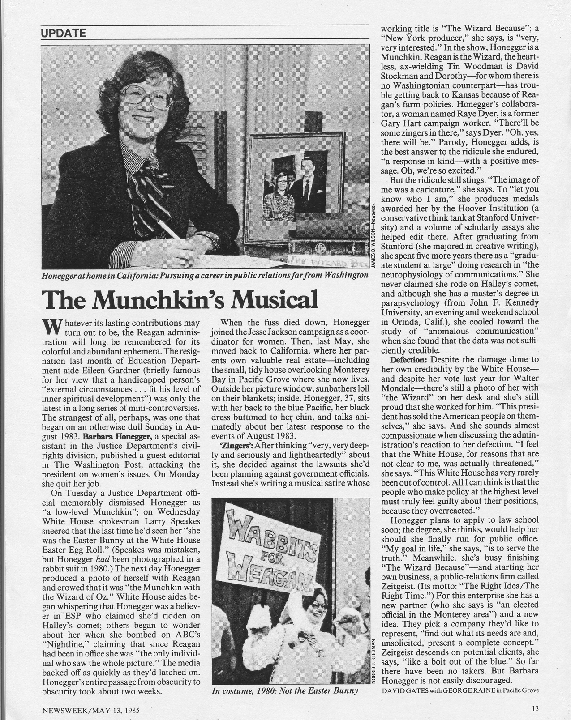
Looking back almost a year later, a great many participants in the Honegger episode are a little sheepish about it (not Honegger herself, however -- more on her views presently). "It was really rather tragic," said Mary Crisp, former co-chairman of the Republican National Committee, who advised Honegger last June, when she first decided to make public her denunciations of the administration's policies on women. "It was like getting into a pretty lake and finding out it was a swamp with a yucky bottom," said Felicity Barringer, a Washington Post reporter who covered the episode. "Well, we certainly all tried to exploit her, I'll tell you that -- poor woman," said Jill Buckley, a Democratic political consultant who briefly tried to help Honegger deal more effectively with the news media.
Remarks like these stemmed from the discovery, made within the first few days of Honegger's big week, that she was, well, odd. She heard voices, which guided her behavior. She had a masters degree in parapsychology. "She turned out, in my estimation, to be a flake," said Sam Donaldson of ABC news.
Donaldson was the substitute host when Honegger appeared on "Nightline" and told the country: "I honestly believe that in the last number of years, certainly since Ronald Reagan gained the presidency, that I am ... the only individual who saw the whole picture."
Earlier in the week she had told Betty Cuniberti of The Los Angeles Times that "a source" using her own voice had told her in January 1980 that Reagan would win the presidency, and that she would work for him on women's issues. "This is hard to believe that it really happened," Honegger said, describing the revelations to her as "channeled information ... as if it were from the future."
Crisp referred Honegger to Rosalie Grattaroti, a publicist who does promotion and marketing work for design firms. Grattaroti thought an op-ed piece in The Post would be ideal, since it would do so much for Honegger's credibility. Sarah McClendon volunteered to make the first contact with Meg Greenfield, editor of The Post's editorial page, and Greenfield expressed interest.
Honegger's first draft was "very operatic," Greenfield recalled, and required a lot of editing. At the same time, Greenfield undertook to confirm that Honegger was indeed who she said she was -- author of the president's executive order setting up a Justice Department review of laws and regulations discriminating against women, then head of the review itself. After a verification process that went on for three weeks, Greenfield satisfied herself that Honegger was as advertised, and that her accusations were well founded.
During those weeks before publication of the article, Greenfield was exposed to Honegger's eccentricities. Some aspects of her behavior reminded Greenfield of other whistle blowers, even of Daniel Ellsberg, the man who provided the Pentagon Papers to The New York Times and The Post. "They are driven, almost messianic, and they greatly overestimate the importance of what they are revealing," Greenfield said of such people. As she came to realize that Honegger was something of an oddball, Greenfield said, she confronted "the most interesting journalistic dilemma I ever faced."
Was a legitimate criticism of a government policy, written by a person undeniably in a position to know the truth, its accuracy independently confirmed, somehow illegitimate because its author was a little strange? After much consideration, Greenfield decided the answer was no -- the article was legitimate and newsworthy. "If she was a kook," Greenfield said, "she was the Reagan administration's kook -- she was their problem."
But the mood quickly changed as Honegger's own personal limitations became clear. "Even some old pros" would have had trouble dealing with the pressure and attention Honegger got, said Martin Anderson, President Reagan's former chief domestic adviser and Honegger's friend and patron. (Anderson had brought her to Washington, and still speaks warmly of her intelligence and ability.) In any event, she did not handle it well, and the image of Honegger as kook quickly bloomed.
A key moment came on Thursday, Aug. 25, when Honegger was invited to join a press conference being staged by the National Organization for Women. It would have been a routine and sparsely attended event, said Dale Russakoff, the Post reporter assigned to cover it, until Honegger's participation was announced. Then a dozen television crews and "a mob" of reporters turned out.
That press conference dismayed and infuriated many of Honegger's friends and helpers, and more than a few of the reporters present. After Honegger gave a meandering, sometimes bewildering performance, "Judy Goldsmith cut her off," Russakoff recalled, and NOW women spirited her to their offices seven floors above.
Mary Berry, a member of the Civil Rights Commission and feminist activist who took part in that Aug. 25 press conference, agrees with Honegger. "If you take a longer view," she said, you see that the administration was "stunned" by the Honegger episode, and changed its ways because of it, appointing more women to top jobs and taking other new initiatives. "We sort of seize upon things that are flamboyant and can be emphasized to advance things politically," she said. "That's standard here in town."
Kathy Wilson of the National Women's Political Caucus -- another participant in that press conference -- sees it differently. She agrees that Honegger's message was powerful, but in the end the episode "fell into the category of Reagan luck," she said. In other words, when the messenger was discredited, Reagan avoided much of the impact of the message.
"Unfortunately," added Mary Crisp, "no one remembers the content, the seriousness" of Honegger's charges.
Hoo-boy, where have we heard that before?
Science Desk; C
PENTAGON IS SAID TO FOCUS ON ESP FOR WARTIME USE
By WILLIAM J. BROAD
1859 words
10 January 1984
The New York Times
Late City Final Edition
English
Copyright 1984 The New York Times Company. All Rights Reserved.
In ''Mind Wars,'' to be published this spring by St. Martin's Press, Ronald M. McRae contends that psychic research was used to evaluate the MX missile ''shell-game'' mode, a $40 billion or so basing scheme in which each MX missile would be secretly shifted among a bevy of concrete bunkers so that Soviet planners would never know which shelter to aim at in a first strike.
Quoting a former White House aide as his source, Mr. McRae says the Pentagon set up experiments in which psychics guessed the position of targets, and that results were positive enough to suggest increased MX vulnerability. The former aide, Barbara Honegger, who holds a degree in parapsychology and left the Reagan Administration this fall, confirmed in a telephone interview that the experiments had been done. But she said she did not know whether the psychic findings had any bearing on the Reagan Administration's decision to scrap the shell-game mode.
National Desk; A
FRIENDS SAY FEMINIST HEROINE IS SINCERE IF ECCENTRIC
By JUDITH CUMMINGS
1152 words
30 August 1983
The New York Times
Late City Final Edition
English
Copyright 1983 The New York Times Company. All Rights Reserved.
LOS ANGELES, Aug. 29 -- When Barbara Honegger denounced President Reagan's commitment to equal rights for women as a ''sham'' and resigned from the Justice Department last week, she became an instant heroine to some women's rights groups.
But some of her new allies have winced as Miss Honegger has linked her beliefs about women's rights to her beliefs about the occult and the supernatural.
As passionately as she has been a student of politics, Miss Honegger is also a dedicated student of the occult, her friends say. She was widely quoted last week as having said that supernatural influences had guided her course, marking her as destined to have an impact on the Reagan Administration and on women's rights. One of these influences, according to an article in The Los Angeles Times, was ''a source'' using her voice that told her that she would become a defender of women's rights in the Reagan Administration. Another article said she had written of ''omens of power'' in Mr. Reagan's ascension.
Miss Honegger denied these accounts and said she never referred to ''a source'' or to ''omens.'' But while making these denials, she also said that she was indeed influenced by an unusual spiritual dynamic.
''I feel like a catalyst,'' she said in a recent interview. ''I am honored to have been used by the Force, if you will, with a capital F, like in 'Star Wars.' That's how I feel. You know, the Zeitgeist of history.''
Miss Honegger also was outspoken about her interest in parapsychology and coincidences. She earned a reputation in the White House as being ''somewhat odd,'' according to Mr. Bandow. As an example, he said, she wrote a manuscript discussing the significance of a particular grouping of three stars on events in the campaign. Mr. Bandow said this ''eccentricity'' did not appear to diminish people's regard for her work.
Reading between the lines here, it's not hard to see that people were happy to use Honegger for their own political agenda, but ended up being embarrassed when they realized that she was nuttier than a Blue Diamond warehouse.
posted by Pat @ 10:08 AM
19 comments